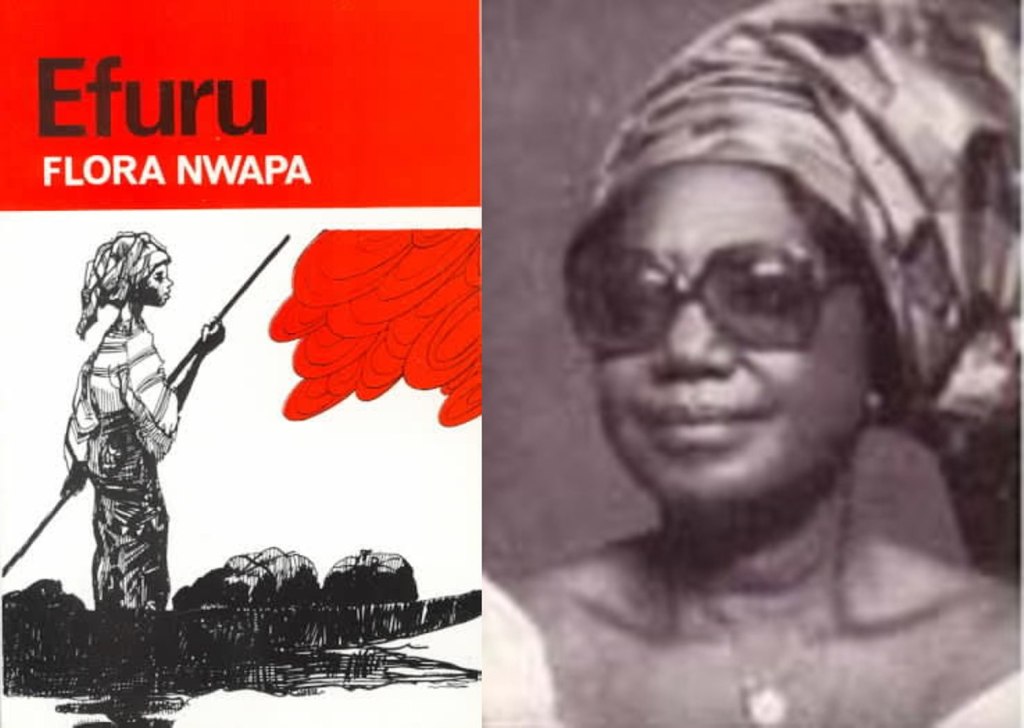
A Womanist Critique of Patriarchy and the Myth of Fertility in Flora Nwapa’s Efuru
Introduction
In a society where a woman’s womb is her currency, what happens when the currency is declared worthless yet the woman herself remains a successful trader, a landowner, and a force in her own right? This is the central question posed by Flora Nwapa’s Efuru. This novel holds the distinction of being the first book written by a Nigerian woman, indeed, by any African woman, to be published internationally (Wikipedia, “Efuru”). This book is set in a rural Igbo community in colonial West Africa. The novel follows its eponymous protagonist through two marriages, the loss of her only child, and her ultimate rejection of the patriarchal structures that define womanhood solely through reproductive capacity.
In this prose piece titled Efuru, a devastating double standard lies. A woman’s worth is measured by her fertility, while men are granted sexual and social freedom regardless of their actions. Efuru’s infertility, or more precisely, her inability to bear children in her second marriage, becomes the lens through which the novel exposes the hypocrisies of patriarchal marriage. Yet Nwapa does not present Efuru as a mere victim. Instead, through a Womanist theoretical lens, this analysis argues that Efuru does more than expose the cruel double standards of patriarchal marriage; it critiques the very limits of seeking validation within that system. Efuru’s journey from hopeful bride to economically independent woman who ultimately walks away reveals that true defiance lies not in proving worth through motherhood, but in reclaiming dignity through economic autonomy, female solidarity, and spiritual self-definition. The novel suggests that for African women, liberation may require stepping outside marriage altogether.
Conceptual Framework: African/Womanist Feminism
The term “Womanism” was coined by Nigerian literary critic Chikwenye Okonjo Ogunyemi in her seminal 1985 essay “Womanism: The Dynamics of the Contemporary Black Female Novel in English.” Ogunyemi distinguishes Womanism from Western feminism by grounding it in African cultural contexts and experiences (Ogunyemi 64). Unlike feminism, which can sometimes be perceived as adversarial to men and dismissive of traditional structures, Womanism embraces community, spirituality, and the complexities of African women’s lives.
Ogunyemi’s framework emphasises several key tenets that are particularly relevant to Efuru. First, Womanism recognises that gender issues cannot be examined in isolation but must be understood within broader contexts of economics, culture, religion, and politics (Arndt 712). Second, it values female solidarity and the networks of support that women create for one another. Third, it acknowledges the importance of economic independence as a foundation for female agency. Fourth, it honours African spirituality and pre-colonial traditions as sources of women’s power. Finally, Womanism critiques patriarchal structures while maintaining a commitment to community; it seeks transformation, not wholesale rejection, of African traditions (Ogunyemi 72).
This theoretical lens is particularly apt for Efuru because it allows for a reading that is both critical of patriarchy and culturally authentic. As critics have noted, Nwapa’s use of dialogue and her focus on women’s daily lives create a “sense of African feminism to emerge, free of Western imposed values” (Wikipedia, “Efuru”). The novel does not advocate for the abandonment of Igbo culture but rather exposes its internal contradictions and calls for a reimagining of women’s roles within it.
Flora Nwapa: Background and Literary Significance
Flora Nwapa (1931–1993) occupies a foundational place in African literature. She was born in Oguta, eastern Nigeria. She was educated at the University of Ibadan and later at Edinburgh University in Scotland. Her first novel, Efuru, was published in 1966 as number 26 in Heinemann’s African Writers Series, making her the first African woman to have a novel published internationally (Wikipedia, “Efuru”).
The novel’s publication came at a significant moment in Nigerian history, just before the outbreak of the Biafran War, and its reception was mixed. While female critics such as Kenyan writer Grace Ogot praised the novel for portraying “vividly the woman’s world, giving only peripheral treatment to the affairs of men,” some male Nigerian writers criticised Nwapa for focusing on women’s concerns (Wikipedia, “Efuru”). This gendered divide in reception itself testifies to the novel’s subversive power. Later critics, however, have recognised Nwapa as a “pathfinder” who broke what scholar Rose Acholonu calls “the seals of silence and invisibility on the female protagonist” created by male writers (Wikipedia, “Efuru”).
Nwapa went on to publish several other novels, including Idu (1970), Never Again (1975), and One is Enough (1981), as well as children’s books and short stories. She also established the Flora Nwapa Company, the first publishing house owned by an African woman, and worked as a teacher and government official. Her legacy as a pioneer of African women’s writing is now firmly established, and Efuru remains a touchstone for discussions of gender, culture, and resistance in African literature (Ogunyemi 45).
Synopsis of the Story
Efuru opens with its protagonist, the beautiful and industrious daughter of Nwashike Ogene, a respected village hero, running away to live with her first husband, Adizua, before the bride price has been paid. This early act of rebellion signals Efuru’s independent spirit. She supports Adizua financially through her trading business and earns the affection of her mother-in-law, Ossai, and her aunt-in-law, Ajanupu. Efuru gives birth to a daughter, Ogonim, but Adizua soon abandons his family, as his own father had done before him. When Ogonim dies in childhood, Efuru discovers that Adizua has married another woman and fathered a child. Despite her in-laws’ attempts to keep her, Efuru returns to her father’s house (Nwapa 45–68).Efuru then marries Gilbert, a childhood friend who has received some Western education. Their first year is happy, but trouble begins when Efuru fails to conceive. Gilbert takes a second wife, Nkoyeni, who bears him a son, and he begins to mistreat Efuru. During a prolonged illness, Gilbert publicly accuses Efuru of adultery, a projection of his own guilt. When he slaps Ajanupu, who defends Efuru, she retaliates by striking him with a pestle handle, breaking his head. Efuru ultimately leaves Gilbert and returns to her father’s house, choosing independence over a marriage that has become a site of humiliation (Nwapa 127–217).
Throughout the novel, Efuru is haunted by dreams of Uhamiri, the beautiful goddess of the lake. A dibia (diviner) confirms that Uhamiri has chosen Efuru as a worshipper. The goddess offers wealth and beauty but withholds children, a fate that initially frustrates Efuru but ultimately becomes a source of spiritual identity. By the novel’s end, Efuru has accepted her childlessness and found peace in her economic independence and her connection to the lake goddess.
Critical Discourse: Themes and Analysis
1. Infertility as Patriarchal Punishment: In the society depicted in Efuru, womanhood is reduced to motherhood. A woman’s identity, status, and worth are all contingent upon her ability to bear children. This cultural imperative is so deeply embedded that even Efuru herself internalises it. After the birth of her daughter Ogonim, she experiences a moment of existential relief, “Is this happening to me or someone I know? Is that baby mine or somebody else's? Is it really true that I have had a baby? That I am a woman after all?” (Nwapa 31). The question reveals how profoundly her sense of self is tied to reproductive capability.When Efuru fails to conceive in her second marriage, this absence becomes her defining “crime.” Her infertility is treated as grounds for suspicion, mistreatment, and ultimately abandonment, even though her husband, Gilbert, has already impregnated another woman. As a 2024 study notes, infertility in patriarchal African societies “is often blamed on women without consideration of the fact that medical causes of infertility are non-discriminatory” (Siddig 4). Nwapa’s novel anticipates this critique by showing how the blame for childlessness falls exclusively on women, regardless of men’s actions or biology.
2. The Double Standard in Marriage and Infidelity: Perhaps the most damning critique in Efuru is its exposure of the sexual double standard. Men can father children outside marriage with impunity; women are accused of adultery for the mere appearance of impropriety. Adizua abandons Efuru and his daughter, yet the community does not condemn him; instead, Efuru’s in-laws pressure her to remain in his house, waiting for his return. Similarly, Gilbert impregnates Nkoyeni before taking her as a second wife, yet it is Efuru who faces suspicion and public accusations.
The climax of this hypocrisy occurs when Gilbert accuses Efuru of adultery during her illness. The accusation is not based on evidence, but on a patriarchal logic that assumes women’s bodies belong to their husbands; any deviation from perfect submission is interpreted as betrayal. As critic Alawia Hassan Mohammed Siddig argues, Nwapa’s work “gives voice to Nigerian women’s aspirations while exposing oppressive structures” that undermine female agency (5).
3. Economic Independence as the Foundation of Efuru’s Defiance: What distinguishes Efuru from countless literary heroines who suffer in silence is her economic autonomy. She is a successful trader who supports herself, her father, and initially both her husbands. When she returns to her father’s house after leaving Gilbert, she does so not as a dependent but as a capable woman who can “care for him better than others”. Her wealth gives her options that other women lack.
This economic independence is central to a Womanist reading of the novel. Ogunyemi observes that for African women, “economic power is prerequisite for true agency” (Ogunyemi 72). Efuru’s ability to walk away from both marriages is not merely emotional strength but a material possibility. She does not need a husband to survive. In this way, Nwapa anticipates a central concern of contemporary African feminism, that women’s liberation cannot be separated from economic empowerment.
4. Language, Naming, and Reclaiming Voice: Throughout the novel, men use language to control women. Public accusations, gossip, and silence are all weapons of patriarchal authority. When Gilbert accuses Efuru of adultery, he does so in front of others, transforming private suspicion into public shame. Yet Nwapa gives Efuru her own voice. Through dialogue with other women, especially Ajanupu. Efuru processes her experiences and arrives at her own conclusions.
Crucially, when Efuru leaves Gilbert, she reclaims her name. She is no longer “Adizua’s wife” or “Gilbert’s wife”; she is simply Efuru, daughter of Nwashike. This linguistic self-possession is a subtle but profound act of resistance. As scholars have noted, the novel’s dialogic style itself “paints a comprehensive, credible, social canvas against which Efuru’s life can be assessed” (Wikipedia, “Efuru”).
5. Female Solidarity: Ajanupu’s Pestle-Handle Act: Among the novel’s most memorable moments is the confrontation between Gilbert and Ajanupu, the sister of Efuru’s former mother-in-law. When Gilbert slaps Ajanupu for defending Efuru, she retaliates by striking him with a pestle handle, breaking his head. This act of violence is the novel’s most dramatic instance of female solidarity. Ajanupu refuses to accept male impunity; she meets violence with violence. The slapping incident reveals Gilbert’s profound disrespect for Ajanupu, who is old enough to be his mother. If he can slap an elder woman who is defending Efuru, it signals that he would eventually turn his violence against Efuru herself. The act transgresses Igbo cultural norms, which dictate that a man, regardless of provocation, has no right to strike an elder.
However, a nuanced Womanist reading must acknowledge Ajanupu’s complexity. She is fiercely loyal to Efuru, but she is also a product of the patriarchy. Her retaliation is a rupture, a moment when a woman violently rejects male arrogance, but it does not dismantle the system that required the defence. As Ogunyemi notes, Womanism recognises that women’s resistance is often partial and contradictory, operating within existing structures even as it challenges them (Ogunyemi 70). Ajanupu’s pestle handle is not a revolutionary weapon; it is a desperate act of protection. Yet it remains significant as one of the few moments in African literature where a woman physically retaliates against male violence.
6. The Lake Goddess: A Womanist Alternative to Motherhood: Perhaps the most distinctive element of Efuru and the one that most clearly distinguishes it from Western feminist narratives is the figure of Uhamiri, the lake goddess. Uhamiri is a fertility goddess who herself has no children. She offers her worshippers wealth and beauty but withholds offspring. Efuru is chosen by Uhamiri, and her dreams of the goddess become a source of both frustration and eventual peace.
The goddess represents a pre-colonial, female-centred spirituality that values prosperity and autonomy over procreation. As the Super summary analysis notes, “Uhamiri’s divine feminine power counterbalances the highly patriarchal nature of Igbo society” (“Efuru Symbols”). Efuru’s alignment with Uhamiri at the novel’s end is a quiet defiance: she refuses to accept that her life is incomplete without a child.
Critic Marie Umeh has described Uhamiri as central to Nwapa’s vision of female empowerment, offering a spiritual alternative to the limitations of patriarchal marriage (Umeh 78). Efuru’s final dream of the goddess suggests that she has come to accept her childlessness not as a punishment but as a different kind of blessing. The novel thus offers a profoundly Womanist resolution: Efuru finds meaning not in motherhood but in economic autonomy, female friendship, and spiritual connection, values that exist outside and beyond patriarchal definitions of womanhood.
7. Gossip as a Weapon: Omirima’s Role: Another character often overlooked is Omirima, who circulates false rumours that fuel the novel’s conflicts. She tells Amede Gilbert’s mother that Efuru is guilty of adultery (Nwapa 215). This moment reveals how gossip functions as a tool of patriarchal control, often wielded by women against other women. Omirima’s rumours intensify the suspicion directed at Efuru, demonstrating that women are not merely victims of patriarchy but sometimes its enforcers. As Ogunyemi observes, Womanism acknowledges this complexity, and women can simultaneously suffer under patriarchal structures and participate in upholding them (Ogunyemi 70).
8. Nwosu: Poverty, Power, and Patriarchal Potential: Nwosu is a hardworking but poor man who does not beat or mistreat his wife, Nwabata. His character raises a provocative question: does poverty prevent the expression of patriarchal entitlement, or does Nwosu represent a genuinely different kind of man? The novel suggests that wealth and power often reveal rather than create a man’s true character. As the saying goes, give a man wealth and power, and you will know his true nature. A poor man cannot afford to womanise or abuse his wife without risking what little he has. The text leaves open whether Nwosu would remain faithful if his circumstances improved, but his presence in the novel complicates any simple equation of poverty with virtue or wealth with vice. Nwosu serves as a counterpoint to Gilbert and Adizua, suggesting that economic structures and moral behaviour are not always aligned, yet the novel never fully endorses him as a model of masculinity, leaving his character deliberately ambiguous.
Conclusion
Efuru begins with a young woman’s romantic rebellion and ends with her quiet liberation. The “barren betrayals” of its subtitle capture both the pain of abandonment and the empowerment that emerges when Efuru stops seeking male approval. Her defiance is not loud, but it is absolute. She does not need a child to be complete; she needs a society willing to see her worth. Failing that, she creates her own completeness, with wealth, friendship, and a goddess who asks nothing of her womb. The novel’s contemporary relevance is striking. In 21st-century Africa, infertility remains a source of stigma, often leading to divorce, ostracism, and psychological distress. The rise of female economic independence echoes Efuru’s trajectory, yet social pressure to marry and bear children persists. Nwapa’s novel offers a timely conversation about reproductive rights, the value of women beyond motherhood, and the role of female networks in resisting patriarchal control. Ultimately, Efuru endures because it refuses easy resolutions. Efuru does not topple patriarchy; she walks away from it. Her story suggests that for many African women, liberation may not come from changing the system but from building lives that transcend it, lives of economic self-sufficiency, deep friendship, and spiritual meaning. In this, Nwapa’s heroine remains a model of defiance for generations of readers.Works Cited
Arndt, Susan. African Gender Trouble and African Womanism: An Interview with Chikwenye Ogunyemi and Wanjira Muthoni. (pp. 709–726.) Signs: Journal of Women in Culture and Society, vol. 25, no. 3, 2000.
Nwapa, Flora. Efuru. Heinemann, 1966.
Ogunyemi, Chikwenye Okonjo. Womanism: The Dynamics of the Contemporary Black Female Novel in English. (pp. 63–80.) Signs: Journal of Women in Culture and Society, vol. 11, no. 1, 1985.
Siddig, Alawia Hassan Mohammed. Conflicts and Restrictions: Flora Nwapa’s Visionary Exposé of Women’s Struggles in Nigerian Marital Contexts. (pp. 1–10.) International Journal of Language and Literary Studies, vol. 7, no. 11, 2024.
Umeh, Marie(Ed). The Poetics of Economic Independence for Female Empowerment: An Interview with Flora Nwapa. Special Issue: Flora Nwapa. vol. 12, no.2, Tana Press, 2017.
Comments