Why Does the UN Security Council Have Five Permanent Members?
The United Nations Security Council is one of the most powerful bodies in the international system. It has primary responsibility for maintaining international peace and security and can impose sanctions, establish peacekeeping operations and authorise certain measures when international peace is threatened. Yet, at the centre of the Council are five countries with a privilege that the other members do not have: permanent membership and the power to veto substantive decisions.
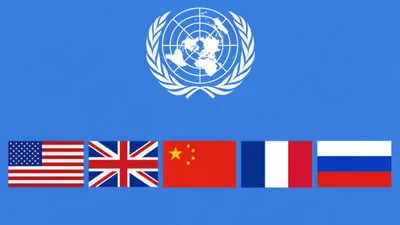
Those five countries are China, France, Russia, the United Kingdom and the United States.
Why were these five countries given permanent seats? Why do they have greater voting power than other members? And, more than 80 years after the United Nations was created, does the arrangement still reflect the world as it exists today?
Frequently Asked Questions
Why are there five permanent members?
They were selected during the creation of the United Nations because of their leading roles in the Second World War and the establishment of the new international system.
Do permanent members have more power?
Yes. Their permanent status and veto give them powers that elected members do not have.
Can the other ten members outvote a permanent member?
Not on a substantive resolution if the permanent member casts a negative vote.
Are permanent members elected?
No. Their permanent status is established by the UN Charter.
Why are there ten other members?
They are elected by the General Assembly for two-year terms, with equitable geographical distribution taken into account.
Does Africa currently have a permanent seat?
No.Why does Africa want permanent seats?
The African Union argues that the current structure does not adequately reflect Africa's place in the international system and calls for at least two permanent seats.
How Did the Five Permanent Seats Begin?
The answer goes back to the end of the Second World War. The League of Nations had failed to prevent another major global conflict, and the countries creating the United Nations wanted a system that could respond more effectively to threats to international peace. Representatives from 50 countries met at the San Francisco Conference in 1945 to draft the UN Charter. Nevertheless, the Charter was signed on 26 June 1945 and entered into force on 24 October 1945. The founders believed that the countries that had played leading roles in the war and in creating the new organisation needed to remain directly involved in decisions concerning international peace and security.
The five chosen were China, France, the Soviet Union, the United Kingdom and the United States. The Soviet Union later dissolved, and the Russian Federation took its place on the Council. Nevertheless the original Security Council had 11 members, five permanent and six non-permanent. In 1963, the General Assembly approved an expansion, increasing the Council to 15 members. Today, there are still five permanent members, while the remaining ten members are elected by the General Assembly for two-year terms.
Why Do the Five Have a Veto?
Permanent membership is important, but the veto is what gives the five countries their most distinctive power. Under Article 27 of the UN Charter, substantive Security Council decisions require at least nine affirmative votes, including the concurring votes of the permanent members. In practical terms, a negative vote from any one of the five permanent members can prevent a substantive resolution from being adopted. An abstention by a permanent member does not automatically block a resolution.
The idea behind the veto was closely connected to the political realities of 1945. The founders wanted the major powers to remain inside the system rather than allowing major decisions to be taken against their interests. This created a compromise. The Security Council could act collectively, but the most powerful states would have a special safeguard.
Are All UN Countries Represented Equally?
In the General Assembly, every UN member state has one vote. The Assembly now contains 193 member states, compared with the original 51 members of the United Nations.
The Security Council works differently. Its membership is limited, and the Charter specifically gives the permanent five their special status. For the non-permanent seats, however, the Charter calls for consideration of equitable geographical distribution.
This creates an important distinction. The United Nations recognises the sovereign equality of its members, but the Security Council does not give every member the same level of influence. That difference is one reason the structure has remained controversial.
Why Has the System Survived for So Long?
One reason is that changing the permanent membership of the Security Council requires an amendment to the UN Charter. Such a change involves a complicated process and requires broad agreement among member states, including the permanent members.
Meanwhile, the world has changed dramatically since 1945. Many countries that are now independent UN members were still under colonial rule when the organisation was founded. The United Nations has grown from 51 original members to 193 today. Political influence, economic power and the number of sovereign states have also changed significantly.
Nevertheless, this has led to a fundamental question: can a Council designed around the international order of 1945 adequately represent the political realities of the twenty-first century?
Why Is Africa Asking for Permanent Seats?
Africa's position has become one of the most prominent arguments for Security Council reform. The African Union's Common African Position calls for at least two permanent African seats, with the same privileges as existing permanent members, including the veto for as long as the veto exists. It also calls for five non-permanent African seats in an expanded Council.
The African argument is based partly on historical representation. Africa has no permanent seat despite the continent's large number of UN member states and the fact that the Security Council frequently deals with conflicts and peace and security issues involving African countries.
But this raises another question. If Africa receives permanent representation, which African countries should occupy those seats? Should particular countries hold them permanently, or should African countries rotate through them? The African Union's position is that Africa should determine which countries occupy its seats. The question of rotation has also been discussed in debates surrounding African representation.
Should Reform Create More Permanent Powers?
This is where the wider debate becomes interesting. If the central problem is inadequate representation, one possible approach is to create additional permanent seats. Another is to expand elected membership and create arrangements that allow different countries and regions to take turns representing their interests. Additionally, there is also a broader geographical question.
The current permanent membership is concentrated among countries in North America, Europe and Asia, with Russia spanning Europe and Asia. Africa, South America and Oceania do not have a permanent member. This raises a question that goes beyond Africa: if the purpose of reform is to make the Council more representative, should reform address all major regions that lack permanent representation rather than simply creating another group of permanently privileged states?
Under such an approach, the discussion would move from asking which countries deserve permanent power to asking how different regions can receive meaningful and recurring representation. That does not invalidate Africa's demand. Rather, it places the African question within the larger debate about how the Security Council should represent the modern world.
Wind Up
The five permanent members of the UN Security Council are not the result of a modern global election. Their position was created in the extraordinary circumstances of 1945, when the United Nations was being built after the Second World War. More than eight decades later, the international system looks very different. The UN has grown to 193 member states, while the Security Council still has only five permanent members.
The debate over reform therefore goes beyond deciding whether Africa should receive permanent seats. It raises a larger question about representation itself.
Should the world respond to today's inequalities by adding more permanent powers, or should it develop a system in which different regions and countries receive meaningful opportunities to participate through elections, rotation or another form of representation? That is ultimately the larger question behind the debate over the future of the UN Security Council.
Comments